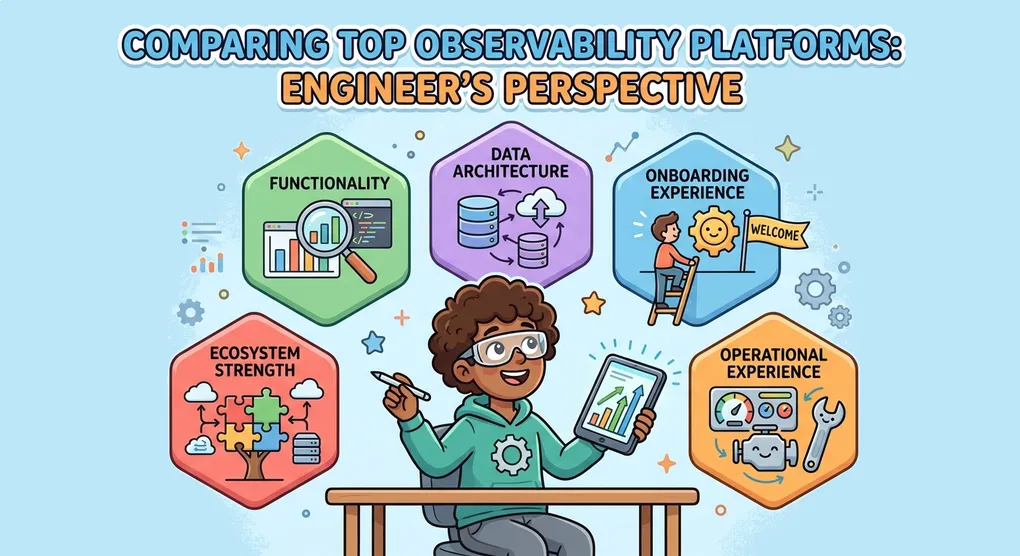
Comparing Top Observability Platforms: Engineer’s Perspective
Modern infrastructure generates massive amounts of telemetry data: logs, metrics and traces.
To manage this complexity, many observability tools have emerged over the past decade. However, comparing them is extremely time consuming because:
- Each tool optimizes for different telemetry signals
- Architecture choices affect scalability and usability
- Marketing claims often hide real engineering tradeoffs
This article compares some of the most widely used observability platforms from an engineer’s perspective.
We evaluate them across several dimensions:
- functionality
- data architecture
- onboarding experience
- operational experience
- ecosystem strength
Cost is intentionally excluded from this analysis as we will analyze the tools from the executive’s prespecive.
Categories of Observability Platforms
Observability platforms historically evolved around individual telemetry signals. For example: logs, metrics & traces. Over the past 10 years, full observability platforms have also started to emerge.
We will introduce the platforms analyzed in this article.
Log Platforms
The following are logging platforms that we are considering:
- Splunk
- OpenSearch
These systems specialize in log indexing and search analytics.
Metrics Platforms
The following are metrics platforms that we are considering:
- Prometheus
- VictoriaMetrics
Metrics platforms optimize for time-series queries and alerting systems.
Distributed Tracing Platforms
For distributed tracing, we only have one platform:
- Jaeger
Tracing platforms focus on request latency and distributed system debugging.
Full Observability Platforms
Finally, for full observability platforms, we will be considering the following tools:
- Datadog
- Dynatrace
- New Relic
- Grafana
- ClickStack
Many of the above tools are paid tools. Essentially, you are paying for consolidation of the 3 types of telemetry data.
Evaluation Framework
To compare observability tools fairly, we evaluate them across five major dimensions:
- Functionality: This dimension evaluates the core capabilities of the platform across logs, metrics and traces. It focuses on how effectively engineers can search, analyze and visualize telemetry data to diagnose production issues.
- Data Architecture: Observability platforms differ significantly in their storage engines, indexing strategies and schema design. These architectural choices determine scalability, query performance and how well the system handles high-cardinality data.
- Onboarding Experience: This dimension examines how easy it is for organizations to instrument applications and start collecting telemetry data. It considers the effort required from both developers (instrumentation) and operations teams (deployment and configuration).
- Operational & Developer Experience: Beyond initial setup, observability tools must support engineers in daily debugging, monitoring and system maintenance. This includes query usability, alerting capabilities and the operational burden required to keep the platform running.
- Ecosystem & Community: A strong ecosystem improves the long-term viability of an observability platform. This includes community support, integrations with other tools and the availability of plugins, extensions and shared knowledge.
Scope & Methodology
This comparison is based on a combination of architectural documentation, production usage patterns and operational experience across modern observability systems.
The evaluation focuses on how these platforms behave from an engineer’s perspective, including factors such as query capability, operational complexity and ease of debugging production systems.
The ratings in the tables are qualitative and reflect common engineering tradeoffs observed when operating these platforms at scale rather than strict benchmark measurements.
Functionality Comparison
Some platforms specialize in a single telemetry signal (for example metrics or tracing). In these cases, the evaluation reflects how the tool performs within its intended domain, rather than attempting to provide capabilities outside its design.
Log Capabilities
| Platform | Indexing Type | Generic Search Latency | Analysis Latency |
|---|---|---|---|
| Splunk | Inverted index | Medium | High |
| OpenSearch | Inverted index | Medium | Medium |
| Datadog | Proprietary index | Low | Low |
| Grafana (Loki) | Label-based indexing | Low | Medium |
| ClickStack | Columnar (ClickHouse-based) | Low | Low |
Notes
Indexing type
- Inverted indexes power traditional log search engines.
- Columnar storage (ClickHouse-style) is optimized for analytics queries.
- Label indexing reduces storage overhead but limits search flexibility.
Search latency
- Tools with heavy indexing often provide faster text search and ease of query.
- Columnar databases tend to perform better for aggregations.
Metrics Capabilities
| Platform | Query Engine | Alert Quality | Complex Math Computation |
|---|---|---|---|
| Prometheus | PromQL | High | Medium |
| VictoriaMetrics | PromQL compatible | High | Medium |
| Datadog | Proprietary | High | High |
| Dynatrace | Proprietary | High | High |
| Grafana (Mimir) | PromQL | High | Medium |
| ClickStack | SQL / ClickHouse | Medium | High |
Notes
- PromQL remains the dominant open standard for metrics queries.
- Proprietary engines often optimize for performance and advanced analytics.
- SQL-based systems provide strong flexibility but may lack ecosystem tooling.
Tracing Capabilities
| Platform | Sampling | Waterfall Visualization | Trace Search |
|---|---|---|---|
| Jaeger | Basic sampling | Good | Limited |
| Datadog | Advanced sampling | Excellent | Good |
| Dynatrace | Adaptive sampling | Excellent | Excellent |
| Grafana (Tempo) | Sampling externalized | Good | Limited |
| ClickStack | Not needed | Good | Medium |
Notes
Platforms like Dynatrace and Datadog provide advanced sampling strategies and rich visualization to help engineers quickly identify latency bottlenecks across services.
Open-source solutions such as Jaeger and Grafana Tempo offer strong foundations but often require additional tooling to achieve the same level of search and analytics capability.
Full Observability Capabilities
| Platform | Cross-Signal Analysis | Search Across Logs/Metrics/Traces |
|---|---|---|
| Datadog | Strong | Yes |
| Dynatrace | Strong | Yes |
| New Relic | Strong | Yes |
| Grafana | Moderate | Partial |
| ClickStack | Moderate | Partial |
Notes
Cross-signal correlation is still one of the hardest problems in observability.
Vendor platforms like Datadog and Dynatrace invest heavily in:
- telemetry correlation
- unified service context
- root cause analysis
Open architectures tend to rely on manual correlation using dashboards.
Visualization Capabilities
| Platform | Unified Context View | Service Mapping | Data Source Integration |
|---|---|---|---|
| Datadog | Excellent | Excellent | Moderate |
| Dynatrace | Excellent | Excellent | Moderate |
| Grafana | Good | Moderate | Excellent |
| Splunk | Moderate | Moderate | Good |
| ClickStack | Moderate | Limited | Moderate |
Notes
Grafana remains one of the strongest visualization layers, while vendor platforms offer more integrated experiences.
ClickStack focuses more on high-scale analytics than deep visualization features.
Data Architecture
| Platform | Storage Engine | Schema Strategy | Cardinality Handling |
|---|---|---|---|
| Splunk | Proprietary index engine | Schema-on-read | Weak |
| OpenSearch | Lucene | Schema-on-write | Moderate |
| Prometheus | Prometheus TSDB | Fixed metric schema | Moderate |
| VictoriaMetrics | Custom TSDB | Flexible metric schema | Strong |
| Jaeger | Backend dependent (Cassandra/Elastic) | Trace schema | Moderate |
| Datadog | Proprietary distributed storage | Hybrid | Strong |
| Dynatrace | Proprietary Grail storage | Schema-flexible | Very Strong |
| New Relic | NRDB columnar datastore | Schema-flexible | Strong |
| Grafana | Backend dependent (Loki/Mimir/Tempo) | Varies by component | Strong |
| ClickStack | ClickHouse columnar DB | Schema-flexible | Very Strong |
Notes
Storage architecture heavily impacts:
- ingestion scalability
- query performance
- cost efficiency
Columnar databases like ClickHouse are particularly effective for high-volume log analytics.
Cardinality Challenges in Observability
High-cardinality telemetry data is one of the most difficult challenges in observability systems.
Metrics platforms often struggle with large numbers of unique labels, while log analytics systems tend to handle high-cardinality data more naturally because each log entry is already stored independently.
Modern observability architectures attempt to mitigate this problem through better indexing strategies, adaptive sampling, or columnar analytics engines.
Onboarding Experience
| Platform | Dev Instrumentation Effort | Instrumentation Type | Ops Effort |
|---|---|---|---|
| Splunk | Medium | Proprietary agents / OpenTelemetry | High |
| OpenSearch | Medium | Beats / OpenTelemetry | Medium |
| Prometheus | Medium | Exporters / OpenTelemetry | Medium |
| VictoriaMetrics | Medium | Prometheus compatible | Medium |
| Jaeger | Medium | OpenTelemetry / Jaeger SDK | Medium |
| Datadog | Low | Proprietary + OpenTelemetry | Low |
| Dynatrace | Very Low | Auto instrumentation | Low |
| New Relic | Low | Proprietary agents + OpenTelemetry | Low |
| Grafana | Medium | OpenTelemetry / OSS agents | Medium |
| ClickStack | Medium | OpenTelemetry pipelines | Medium |
Notes
The main operational effort typically comes from:
- pipeline configuration
- data routing
- infrastructure scaling
Vendor platforms reduce this burden through managed services.
The Role of OpenTelemetry
Modern observability ecosystems are increasingly built around OpenTelemetry, an open standard for collecting logs, metrics and traces.
OpenTelemetry provides a vendor-neutral instrumentation framework that allows applications to emit telemetry data once and send it to different observability platforms. This makes changing observability vendors easier.
Many platforms in this comparison now support OpenTelemetry, which significantly reduces vendor lock-in and simplifies instrumentation when organizations migrate between tools.
Operational & Developer Experience
| Platform | Maintenance Burden | Alert Intelligence | Query Experience |
|---|---|---|---|
| Splunk | High | Medium | Good |
| OpenSearch | Medium | Medium | Good |
| Prometheus | Medium | High | Excellent |
| VictoriaMetrics | Medium | High | Excellent |
| Jaeger | Medium | Low | Moderate |
| Datadog | Low | High | Excellent |
| Dynatrace | Low | Very High | Excellent |
| New Relic | Low | High | Excellent |
| Grafana | Medium | High | Excellent |
| ClickStack | Medium | Medium | Excellent |
Notes
Fully managed platforms like Datadog and Dynatrace minimize maintenance overhead but trade off flexibility and transparency.
Open-source stacks built around Prometheus and Grafana offer excellent query capabilities but require more operational effort to scale and maintain.
Ecosystem & Community
| Platform | Community Support | Integrations |
|---|---|---|
| Splunk | Strong | Strong |
| OpenSearch | Strong | Strong |
| Prometheus | Very Strong | Very Strong |
| VictoriaMetrics | Strong | Strong |
| Jaeger | Strong | Strong |
| Datadog | Strong | Very Strong |
| Dynatrace | Moderate | Strong |
| New Relic | Strong | Strong |
| Grafana | Very Strong | Very Strong |
| ClickStack | Emerging | Moderate |
Notes
The strength of a platform’s ecosystem often determines how quickly teams can adopt and extend it.
Projects like Grafana and Prometheus benefit from extremely large open-source communities and a rich plugin ecosystem. Vendor platforms such as Datadog and Dynatrace provide strong integrations, but innovation typically occurs within the vendor’s product roadmap rather than the broader community.
When Each Platform Makes Sense
While some platforms perform better overall, different tools excel in different operational environments.
When Splunk Makes Sense
Splunk remains a strong choice when organizations require powerful log search and advanced log analytics capabilities, especially in environments with complex operational workflows.
When Prometheus + Grafana Makes Sense
The Prometheus and Grafana stack is ideal for organizations that prefer open-source infrastructure and want full control over their observability systems. It is particularly well suited for Kubernetes-based environments.
When Datadog Makes Sense
Datadog is often the easiest platform to adopt when teams want a fully managed observability solution with strong cross-signal correlation and minimal operational overhead.
When Dynatrace Makes Sense
Dynatrace excels in environments that require automatic instrumentation and deep service topology insights, making it attractive for large enterprise deployments.
When ClickStack Makes Sense
ClickStack is emerging as a strong option for organizations dealing with extremely large volumes of telemetry data, where columnar analytics engines can provide significantly faster large-scale queries.
Which Observability Platforms Are Best for Engineers?
Ignoring cost, the most powerful and versatile platforms today are:
Best Overall Platforms
- Datadog
- Dynatrace
Strengths:
- excellent cross-signal correlation
- powerful analytics
- strong automation
- low operational burden
Best Open Source Stack
The most flexible open stack today is:
Grafana + Prometheus + Loki + Tempo
Strengths:
- massive community support
- open ecosystem
- flexible architecture
Best High-Scale Log Analytics
ClickStack is emerging as a strong option when:
- log volumes are extremely large
- columnar analytics performance is required
- organizations want SQL-style querying
Conclusion
Observability platforms vary significantly in architecture, usability and operational tradeoffs.
Some tools specialize in individual telemetry signals, while others aim to deliver full observability across logs, metrics and traces.
In my opinion, the most important factors for an engineer include:
- onboarding experience
- operational complexity
- features that promote ease of use
In a future article, we will evaluate observability platforms from an executive perspective, where cost governance, scalability and platform strategy become the dominant concerns.