Splunk Cost Management: A Framework to Control Log Ingestion Surges
Splunk is one of the most powerful observability platforms on the market. It’s also one of the platforms that can cause stress to its operations and finance teams. If you are spending a lot on Splunk Cloud, you are not alone.
In my previous post I covered the tactical side: how to audit your log ingestion identify waste and cut costs quickly. That work has real value. But the teams that do it once declare victory and move on will find themselves back in the same conversation a few months later.
The deeper problem isn’t a configuration issue. It’s a structural one. And structural problems require a structural solution: cost management.
Why One-Time Cost Reduction Doesn’t Last
Every time your organization ships a new feature onboards more users or expands into a new market log volume grows with it. That’s not a sign of dysfunction. It’s a natural consequence of a healthy scaling platform. The problem is that log ingestion tends to grow faster than the business value it delivers.
There’s also the unpredictable side: ingestion surges. These don’t come from planned growth. They can be caused by various reasons like traffic spikes, new features causing unexpected log surges, testing and more. By the time anyone notices, you’ve already burned through a meaningful portion of your daily license.
This is why treating Splunk cost as a one-time cleanup project doesn’t work. You reduce it, you ship more software and a few quarters later you’re back at the same meeting asking the same questions with the threat of a larger bill.
The organizations that escape this cycle aren’t the ones that are better at cleanup. They’re the ones that stopped relying on cleanup as their primary strategy.
What Cost Management Actually Means
Cost management is a term that gets used loosely so it’s worth being precise:
Splunk Cost Management: Clear rules, ownership and feedback loops that keep observability costs predictable as the organization grows.
The emphasis here is on predictable. Financial operation (FinOps) team don’t need your Splunk costs to be low. They need them to be foreseeable. Surprises are what create organizational friction and erode trust between teams.
Without a management framework in place, costs scale faster than business value. Teams ship logs without thinking about volume. No one owns the top ingest sources. There’s no visibility into who’s responsible when a spike occurs. And when leadership asks for answers, the response is a scramble.
With a strong cost management framework, engineering teams can still move fast. But, guardrails are introduced to prevent the budget from blowing up or handle ingestion spike. The goal isn’t to slow anyone down. It’s to treat observability cost with the same organizational seriousness as security or reliability.
The StarCluster Splunk Cost Management Framework
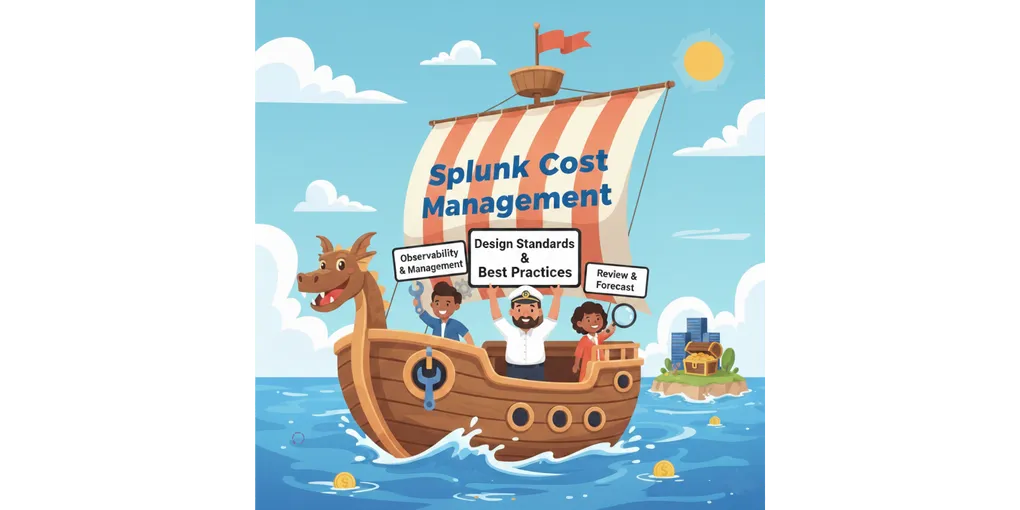
What follows is the framework we built and refined: StarCluster Splunk Cost Management (SSCM) Framework. It’s organized into three pillars and each pillar can contain multiple principles. The principles within each pillar are designed to be adapted to your organization’s culture and tooling.
Pillar 1: Design Standards & Best Practices
This pillar is about prevention. The cheapest log to ingest is the one that was never written in the first place.
Principle 1.1: Log Design Standards give engineering teams a consistent framework: what is the log format, what are the must-have fields and more. Basically, it relates to how the log message actually looks like and does not relate to ingesting logs into Splunk.
Principle 1.2: Ingestion Best Practices cover the best practices of what and how logs are ingested into Splunk. Usually, this means assigning the right log levels, where to send the logs to, sampling & filtering recommendations, etc.
A single internal short document that answers both of these types of questions clearly compounds in value across the company. Based on my own experience, a long standard document is typically not adhered to by other cowokers.
Pillar 2: Observability & Management
You cannot manage what you cannot see. This pillar is about making cost visible, attributing it to the right owners and automating guardrails. This ensure the organization isn’t relying on heroes to catch every surge.
Principle 2.1: Visibility & Attribution means building dashboards that show ingestion volume broken down by source team and application. When cost is invisible, no one feels responsible for it. When it’s visible, attributed teams naturally begin to treat it as a knob that they own. However, visibility without ownership and accountability is usually insufficient, which is why we propose our next principle.
Principle 2.2: Ownership & Accountability turns attribution into action. You want to start a team that has Splunk cost management as part of their responsibilities. This team would then create policies and help to drive the adoption of those policies in the organization. I like to call the Splunk Cost Management Team (SCMT).
Principle 2.3: Guardrails & Automation address the reality that some surges move faster than any human can respond to. Automated alerts can help to notify teams that unexpected surges have occurred. This enables teams to reduce log ingestion in a timely manner.
Pillar 3: Review & Forecast
The SSCM framework is only useful when teams are proactively taking ownership of their own log ingestion. Asking teams to perform review and optimize is our recommended way to encourage taking ownership of their log ingestion.
Principle 3.1: Review Cadence means scheduling regular sessions (weekly/monthly/quarterly) where app teams review their log ingestion dashboards. The goal is to find anomalies. SCMT should also review an organization-level dashboard to see if there are any new Splunk indices that have risen in log ingestion. This principle can be automated to be done by AI but periodic manual review is still advisable.
Principle 3.2: Continuous Optimization is where tactical cost reduction work meets with the management framework again. By using insights from the dashboard, teams are now empowered to optimize log ingestions for their app (by dropping, removing, changing logs levels and more).
Principle 3.3: Periodic Forecasting is the capability that most directly helps with contract renegotiation with Splunk during renewal. By having proper dashboards, SCMT can confidently predict future ingestion based on past data. This allows the FinOps or Procurement team to know exactly how much to purchase.
Cost Management vs. Cost Reduction: The Strategic Difference
These two concepts are often conflated and it’s worth making the distinction explicit, especially for leadership conversations.
Cost reduction is tactical. It’s the one-time cleanup, the filter that eliminates a noisy source, the index tuning that recovers headroom. It is valuable and necessary. But on its own it does not make costs predictable. It resets the clock.
Cost management is strategic. It is the operating system that keeps costs predictable over time. It will sometimes deploy cost reduction as a tool to stay within its targets, but management is what ensures the need for emergency reductions doesn’t recur on a quarterly basis.
A useful analogy: cost reduction is bailing water out of a boat. Cost management is patching the hull.
Organizations that have only ever done cost reduction will keep bailing. Organizations that invest in cost management build and maintain a boat that doesn’t sink.
What Mature Splunk Cost Management Looks Like
When this framework is functioning well, the signals are clear:
- Log ingestion is predictable. Leadership is not surprised by the monthly bill and FinOps can model future observability costs as a reliable line item (based on each team’s forecast).
- Surges are handled efficiently. When an ingestion spike occurs, the SCMT knows who owns it, what caused it and how to respond. This is because the playbook to handle surge already exists.
- Costs can be forecast. SCMT should be able to provide a rough estimate for the next year based on past data due to well-controlled log ingestion growth.
- Adoption of SSCM is progressive depending on a team’s years since founding.. SSCM should look different for new teams and mature teams (in terms of years of founding). New teams will adopt fewer best practices whereas mature teams are expected to adopt most best practices. New teams often have less sessions and need to move fast. Mature teams often have lots of sessions and need stability (rather than moving fast).
- Log ingestion grows slower than the business. This is the ultimate indicator of a mature framework. It means teams are making deliberate choices about what they log. They no longer default to logging everything and letting someone else deal with the cost.
Getting Started: A Practical Path Forward
Building a cost management framework doesn’t require a large team or a long runway. It requires a clear mandate and a few concrete first steps.
1. Form a small Splunk Cost Management team with explicit responsibility for this domain. This should include at minimum someone from platform engineering with Splunk admin visibility. Without clear ownership this work will always lose to other priorities.
2. Publish a simple standards and best practices documents for engineering teams. Refer to Pillar 1 for more details on the content of these 2 documents. These 2 documents are the foundation other teams will build upon them.
3. Define what “wasteful logs” means for your organization. Common examples include debug logs left active in production repeated identical error messages emitting in tight loops and high-cardinality fields that are never queried. Make the definition concrete and shared.
4. Map your top 10 ingest sources to their owning teams. Then schedule conversations with each of those teams. Walk them through the best practices. If they have wasteful logs, surface it constructively. If they need help reducing volume, do the work alongside them and document the solution. That documentation will then become a reusable blueprint for every future conversation.
Three months after the initial rollout, follow up with those teams. Ask what worked, what created friction and what they didn’t understand. Use that input to refine the best practices document before rolling it out to the rest of the organization.
As the framework matures, consider investing in tooling that automates more of the attribution and detection work. There is also a growing opportunity to apply AI-assisted analysis to proactively surface anomalies and optimization candidates. This is a natural evolution once the foundational practices are established.
Final Thoughts
Splunk is an investment. Like any significant investment, it deserves to be managed, not just periodically audited.
The organizations that get this right don’t do it by logging less. They do it by logging with intention and building systems that keep cost visible & attributed. They also treat observability spend as a first-class organizational concern rather than an engineering afterthought.
If you’re in the middle of a cost reduction effort right now, use this moment as the catalyst to build something that lasts. The return on a well-designed cost management framework is not just lower bills. It’s the organizational confidence that comes from knowing your observability costs are under control no matter how fast you grow.
Have questions about how to adapt this framework to your environment? I’d love to hear from you.