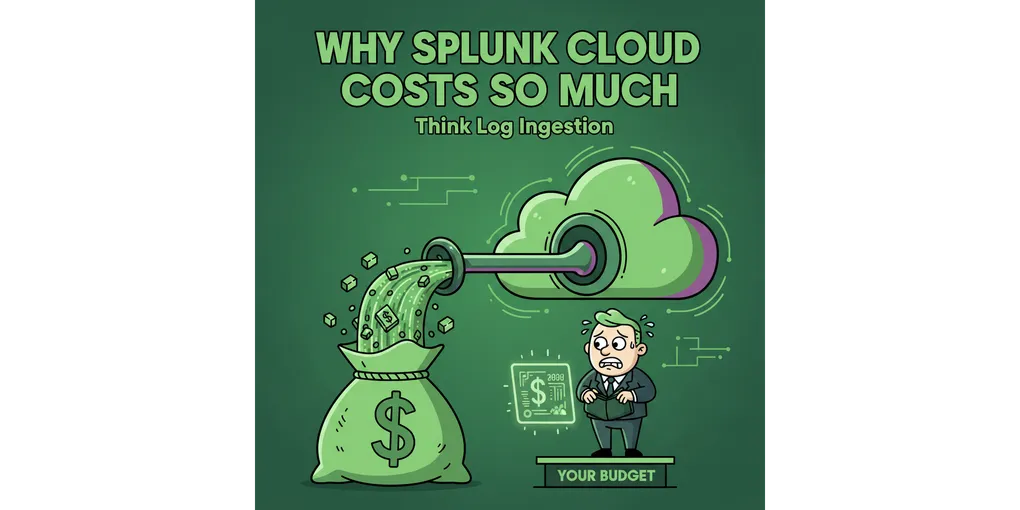
Why Splunk Cloud Costs So Much
If your organization is using or planning to use Splunk Cloud, you may have already noticed one thing: it’s not cheap.
But why is Splunk Cloud so expensive, and what actually drives its cost?
Understanding Splunk Cloud’s cost structure is critical for IT leaders, engineers, and finance teams. Once Splunk is deployed, costs tend to rise faster than expected.
1. Data Ingestion: The Primary Cost Driver
For Splunk Cloud, the dominant cost driver is daily data ingestion volume (GB/day). In most real-world deployments, data ingestion represents 70% or more of total Splunk Cloud spend.
A key detail that is often misunderstood:
Splunk Cloud requires organizations to license based on their maximum daily ingestion limit, not average usage.
This means:
- Occasional ingestion spikes matter
- One noisy data source can permanently raise costs
- You pay for peak usage, even if it happens infrequently
Every log, metric, or event sent into Splunk Cloud counts:
- Verbose application or debug logs
- Infrastructure and container logs
- Network and security telemetry
- Duplicate or low-value data
As environments scale, ingestion often increases silently until teams either hit their licensed limit or face a steep renewal.
2. Storage and Retention
Beyond ingestion, data retention and storage also represent a meaningful portion of the total cost, depending on retention policies and searchable history.
Longer retention means:
- More indexed data
- Higher storage consumption
- Higher recurring cloud charges
This is especially impactful for regulated industries or organizations with strict audit requirements.
3. Premium Apps and Add-ons
Splunk Cloud offers powerful premium capabilities such as:
- Security analytics
- IT operations intelligence
- Observability
These often come with separate pricing tiers, adding additional costs on top of core ingestion and storage.
How Much Does a Small-to-Mid Size Tech Company Typically Pay?
Based on my experience:
- Small companies (50–300 employees): ~USD $150k – $400k annually
- Mid-size companies (300–1000 employees): ~USD $300k – $1M annually
Splunk Cloud is not cheap — but when used properly, the value can outweigh the cost.
Cloud Convenience vs Cost Predictability
Splunk Cloud removes much of the operational burden of running Splunk infrastructure, which is a real benefit. However, this also means:
- Less direct control over cost levers
- Ingestion growth translates directly into higher spend
- Fewer natural brakes on data volume growth (unlike on-prem hardware limits)
Because pricing is tied to licensed peak ingestion, cost predictability becomes a real challenge without active governance.
The Hidden Cost: Complexity
Splunk Cloud is extremely flexible. But flexibility without discipline is expensive.
Poorly designed ingestion pipelines, low-value log messages, and unused dashboards can quietly inflate costs month after month.
Many organizations only discover this when:
- Daily ingestion limits are exceeded
- Renewal quotes come back far higher than expected
- Splunk reaches out about unusually high log ingestion
From My Experience
In my experience reducing Splunk Cloud costs, spending almost always increases when there is no systematic way to identify and control wasteful log ingestion.
Splunk Cloud cost is primarily driven by the licensed maximum daily ingestion volume. As a company grows, log volume grows too:
- Product usage increases
- Users spend more time in the application
- Engineering teams grow
- Application features expand
Without deliberate attention, Splunk spending can grow faster than revenue.
My advice: Companies should regularly monitor Splunk cost and build processes to actively control it.
Why This Matters
Splunk Cloud is a powerful platform. But when pricing is based on maximum daily ingestion, small technical decisions can have outsized long-term financial consequences.
If this resonates with what you’re seeing, feel free to reach out or follow along. I’ll be sharing practical ways to control Splunk Cloud costs in my next post — often by double-digit percentages, without sacrificing the insights teams rely on.
(Original article was first posted on LinkedIn)